
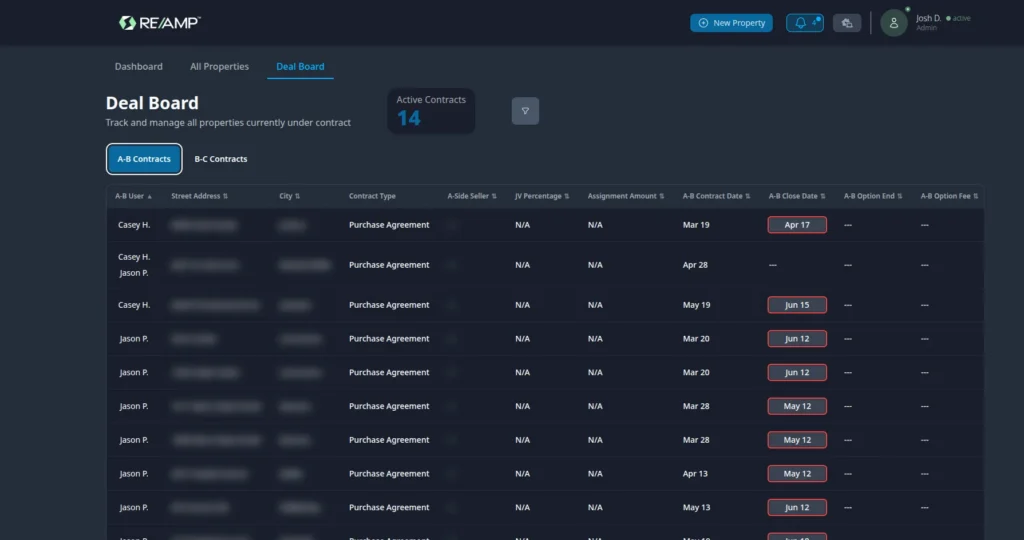
Every Side Of The Deal, Built In.
Acquire it, manage it, dispose of it: however that exit actually looks. RE/AMP keeps acquisition contracts, property management status, and disposition contracts connected to the same property record without forcing your business into a single investment strategy.
Learn More About Us
See how you can manage A-B and B-C contracts and rehab operations in RE/AMP
Book A CallOne Property Can Have More Than One Path
Real estate deals don’t all follow the same timeline.
Some properties are acquired and sold almost immediately. Others are acquired, held, renovated, and sold months later. A property might be wholesaled to another investor, listed for a retail buyer, or held while your team completes substantial work.
Software built around a single transaction model can make those differences difficult to represent.
RE/AMP keeps the property’s acquisition, holding period, and eventual disposition connected while allowing you to choose the path that actually fits the deal.
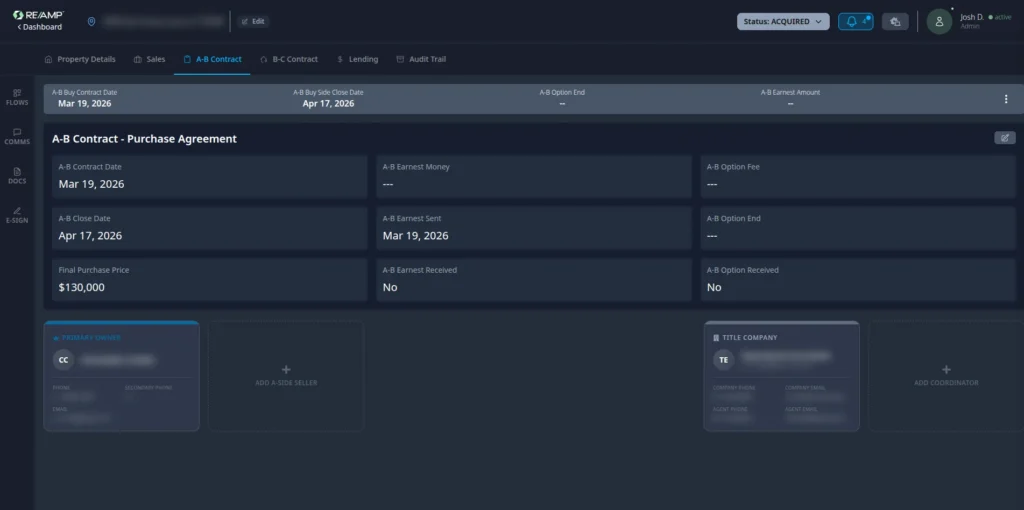
Acquisition Contracts: A → B
Every deal starts with an acquisition.
The acquisition represents the transaction between your business and the seller: the process of taking the property into your control.
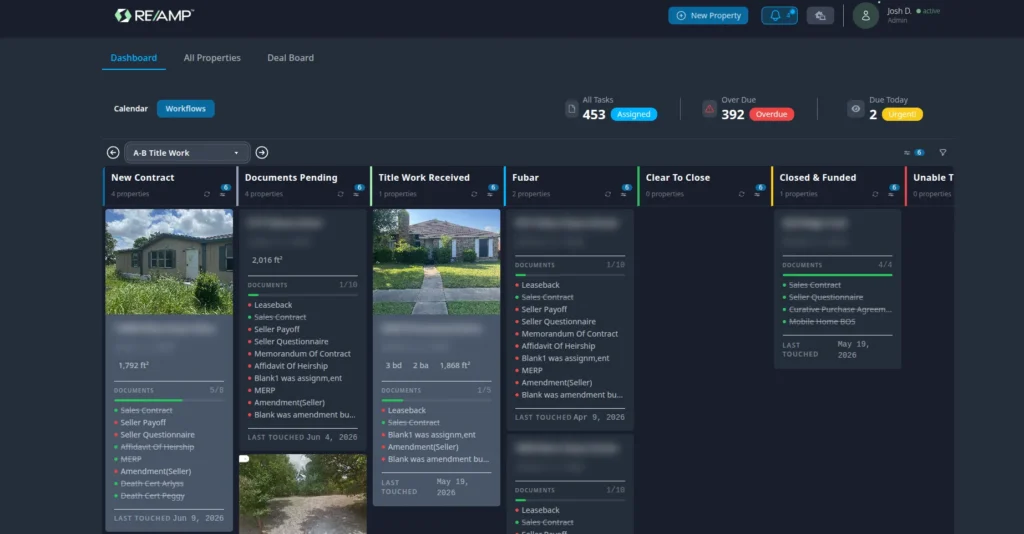
RE/AMP keeps the acquisition contract directly associated with the property so the paperwork surrounding the purchase stays with the deal it belongs to.
Instead of maintaining a separate contract repository and trying to connect documents back to properties later, the acquisition agreement becomes part of the property’s record.
Whether you’re purchasing a single-family home, vacant land, a mobile home park, or another type of investment property, the acquisition side of the transaction remains tied to the property throughout its lifecycle.
Manage Only: Hold It, Work It, Then Decide
Not every acquisition is immediately headed for a buyer.
Sometimes you acquire a property because you intend to hold it, renovate it, improve it, or otherwise work on it before deciding how and when to sell.
RE/AMP lets you flag a property as Manage Only to represent that state.
A Manage Only property does not require a disposition contract simply because you’ve acquired it. You can continue managing the property, completing rehab work, tracking tasks, storing documents, and communicating with the people involved without artificially forcing the property into a sale process.
When you’re eventually ready to exit the property, you can move into the appropriate disposition process.
This gives your team an accurate representation of what is actually happening with the property instead of treating every acquisition as an immediate flip.
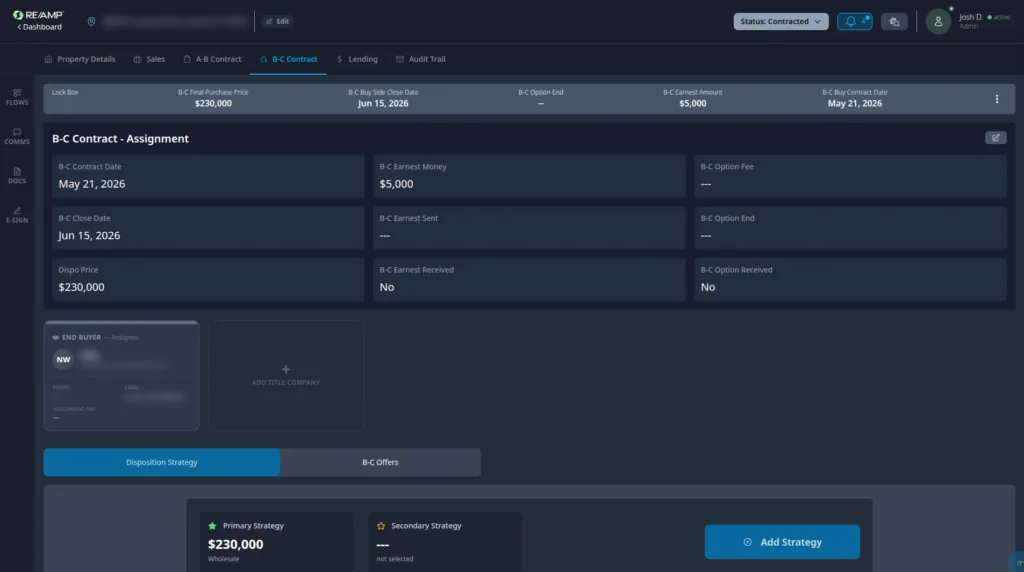
Disposition Contracts: B → C
Disposition is the other side of the transaction: selling the property to someone else.
But there isn’t only one way to dispose of a property.
A property might be:
- Listed through a real estate brokerage or MLS for a retail buyer
- Sold directly to an end buyer
- Assigned or wholesaled to another investor
- Disposed of through another strategy appropriate to the deal
RE/AMP‘s disposition contract framework isn’t tied specifically to wholesaling.
Wholesale is one possible disposition strategy: not the definition of disposition.
The important relationship is that the property moves from your ownership or control to the next party, with the appropriate disposition paperwork associated with the same property record.
How Acquisition, Management, And Disposition Work Together
1. Acquire The Property
Complete the acquisition from the seller and attach the acquisition contract to the property.
A → B
2. Decide What Happens Next
The property can move toward disposition immediately, or it can be flagged Manage Only if you’re holding it to complete rehab, improvements, or other work.
3. Work The Property (if manage only)
While in Manage Only status, your team can continue managing tasks, documents, communication, and other property activity without requiring a disposition contract.
4. Prepare For Disposition
When you’re ready to sell, attach the appropriate disposition contract to the property.
B → C
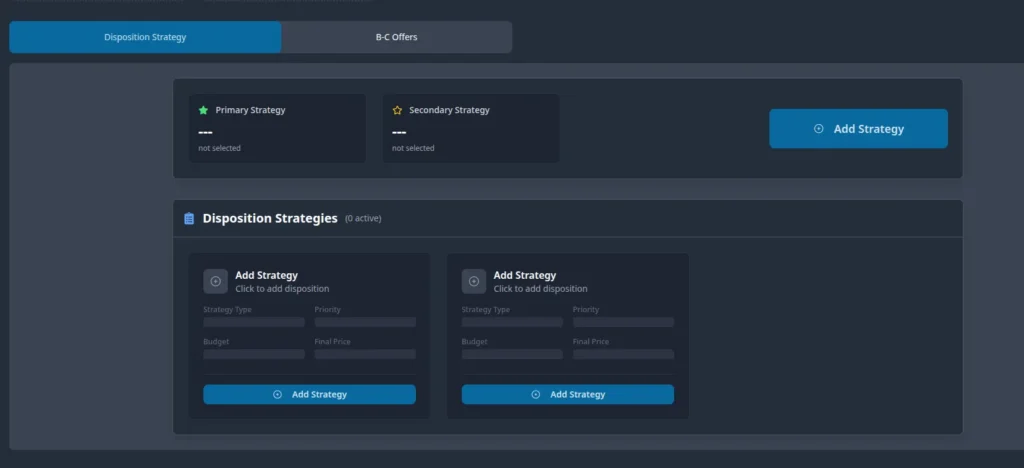
5. Choose The Exit Strategy
The disposition can take whatever form makes sense for the deal: such as a retail sale through a brokerage or a wholesale assignment to another investor.
6. Keep The Full Record Together
The acquisition contract, property history, management activity, and eventual disposition documents remain connected to the same property record.
A Real-World Example
Consider two properties acquired by the same investment company.
The first is purchased below market value and needs a significant rehab. The company flags it Manage Only, assigns renovation tasks, tracks the property’s documents and activity, and works on the property for several months.
There is no need to create a disposition contract until the property is actually ready to sell.
The second property follows a completely different path. After acquisition, the company quickly finds another investor interested in the deal and completes a wholesale assignment within a week.
Same system.
Same property-centered record.
Two completely different paths from acquisition to disposition.
Why Flexible Deal Paths Matter
Support More Than One Investment Strategy
Your CRM shouldn’t assume that every property is a wholesale deal. RE/AMP supports acquisition, holding, rehab, retail disposition, and wholesale disposition within the same property-centered system.
Represent The Property Accurately
A property you’re actively rehabbing shouldn’t look like a property waiting for a buyer. Manage Only gives your team a clear way to represent that difference.
Keep Contracts With The Property
Acquisition and disposition paperwork stays associated with the property instead of being scattered across separate contract management systems.
Preserve The Complete Deal History
The property’s record can contain the acquisition, work performed while you held it, communications, documents, and eventual disposition.
Adapt To The Deal
A property’s path doesn’t have to be determined before you acquire it. You can acquire first, decide how the property will be handled, and move into disposition when the time is right.
Frequently Asked Questions
About Dispositions, Acquisitions and Contracts
An acquisition contract documents the transaction in which you acquire a property from the seller. In RE/AMP, the acquisition contract is associated directly with the property's record.
Manage Only identifies a property that you have acquired but intend to hold and work on rather than immediately move toward disposition.
No. A property can remain in Manage Only status while your team performs rehab, improvements, or other work. A disposition contract can be added when you're actually ready to sell.
A disposition contract represents the transaction through which you sell or otherwise transfer the property to the next party.
No. Wholesaling is one possible disposition strategy. A property can also be sold to a retail buyer, listed through a brokerage or MLS, or disposed of through another appropriate strategy.
Yes. A wholesale assignment can be represented as a disposition path for a property.
Yes. Disposition is not limited to wholesale transactions and can represent a retail sale or other exit strategy.
Yes. A property can be flagged Manage Only while your team holds, renovates, or otherwise works on it before beginning the disposition process.
Yes. Both sides of the transaction remain associated with the same property record, allowing your team to maintain the property's complete contract history.
One Property. Whatever Path The Deal Takes.
RE/AMP lets you acquire a property, hold and work it when necessary, and eventually dispose of it through the strategy that makes sense for the deal: all while keeping the contracts, documents, tasks, communication, and history connected to the same property.